Boat Loans Australia Boat Loan Repayment Calculator
Planning your dream boat purchase? Explore potential repayment scenarios with our Boat Loan Calculator. Test different interest rates, loan amounts and repayment terms to estimate costs and better understand your potential finance commitments.
Calculator results are estimates based on the inputs and assumptions used, for general information only. They are not quotes, offers, approvals, eligibility decisions or personalised recommendations, and do not indicate that a lender will provide credit. Actual repayments and costs may differ.
Boat Loan Details:
Important!
Boat Loan Interest Rates differ from lender to lender and will depend on your individual circumstances (credit history, employment status, age, etc.).
Boat Loan Amortisation Calculator
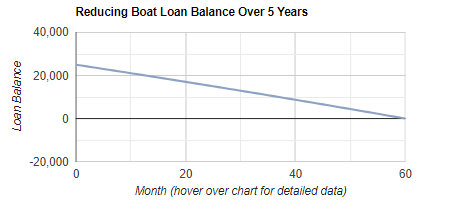
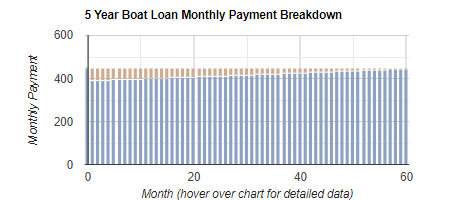
The following amortisation graphs detail month-by-month data on the progress of the proposed loan. The first chart below examines the reducing loan balance over the course of the finance contract term. The second graph illustrates the portion of each monthly repayment allocated to payment of interest vs principal reduction.
How to use our Boat Loan Repayment Calculator
Our Boat Loan Repayment Calculator helps you estimate repayments for boat finance before you apply, so you can plan a budget that suits your lifestyle and compare different loan terms, interest rates and deposit options. It is important because small changes to the interest rate or loan term can materially change your monthly repayment and the total interest paid over the life of the loan.
How to complete the calculator for the best estimate
1. Purchase Price
Enter the total purchase price of the boat in Australian dollars as a whole number only, with no commas or decimal points. For a more realistic result, consider whether you want to include other costs you may finance, such as stamp duty, registration, insurance and accessories, where applicable.
2. Deposit or Trade-in Value
If you have cash savings or a trade-in, enter that amount as a whole number. A larger deposit generally reduces the amount you need to borrow, which can reduce repayments and total interest.
3. Term of Loan (Years)
Select the number of years you want to repay the loan over. A longer term usually lowers repayments, but often increases the total interest cost across the loan.
4. Interest Rate (Per Annum)
Choose an indicative annual interest rate for the simulation. Use a conservative rate if you are unsure, and consider testing multiple rates to understand best and worst case affordability. Your actual rate may differ based on lender policy and your personal circumstances.
5. Calculate
Select calculate to generate your estimate.
How to interpret the results
Review the estimated repayment amount and the amortisation information. The reducing balance chart shows how the loan balance may fall over time. The interest versus principal chart shows how early repayments typically include a higher interest portion, with more principal repayment later in the term.
ASIC and lending disclaimer: This calculator provides general information only and does not consider your objectives, financial situation or needs. Results are estimates and may not include lender fees, ongoing charges or changes in rates. Credit is subject to approval and you should check the final loan contract terms and your ability to meet repayments before proceeding.
Welcome to the world of boat ownership! If you’re dreaming about weekends on the water, wind in your hair, you’re not alone. However, new boat owners often find themselves surprised by the real costs of owning a boat. It's crucial to understand that budgeting goes beyond just the initial purchase price. Planning ahead can save you from unexpected financial stress. - read more
Investing in a fishing boat can be an exciting and rewarding experience, but it's important to make sure you're getting the most value for your money. There are several key factors to consider when buying a fishing boat, including your specific needs, budget, and financing options. It's also important to research boat brands and negotiate the sale to ensure you're getting a fair price. - read more
Are you dreaming of purchasing your dream boat but worried about getting approved for financing? Ensuring you have a good creditworthiness is essential when it comes to obtaining boat financing. In this blog post, we will explore the importance of creditworthiness in boat financing and provide valuable tips on how you can improve your creditworthiness to increase your chances of getting approved for boat financing. - read more
Purchasing a boat is an exciting venture, but it usually requires a substantial financial commitment. For many Australians, securing a boat loan is a practical way to make this dream a reality. - read more
Secured and unsecured boat loans can both help Australians finance a vessel, but they work in different ways. The key differences usually come down to collateral, interest rates, repayment terms, borrowing limits, application requirements and the risks you accept if repayments become difficult. - read more
Buying your first boat is an exhilarating adventure filled with dreams of open waters and sunny days. It's a significant milestone for many Australians longing to embrace the coastal lifestyle. But before diving in, it's crucial to navigate this journey with the right knowledge. - read more
A new summer 2026-27 marine distribution outlook published by the Boating Industry Association has given Australian boat buyers a more detailed picture of the market they may face over the warmer months: not a simple boom or slowdown, but a patchwork of stronger used-stock activity, softer day-boat trading, higher price sensitivity and continuing workshop-capacity constraints. - read more
Australia’s used-boat market is showing signs of renewed movement heading into summer, with BoatsOnline’s October 2026 market insight reporting stronger sales activity across its marketplace. For households weighing up a second-hand vessel, the update is a useful reminder that a softer economy does not automatically mean a simple buyer’s market, especially where well-presented stock is moving quickly. - read more
The Reserve Bank of Australia’s 3 November 2026 decision to lift the cash rate target by 25 basis points to 4.85 per cent has added another practical checkpoint for Australians thinking about financing a boat this summer. While marine finance rates are set by individual lenders rather than the RBA directly, a higher cash rate environment can flow through to funding costs, repayment expectations and the way households assess discretionary purchases. - read more
The Boating Industry Association has launched its sixth annual Discover Boating campaign for the 2026/27 summer season, aiming to bring more Australians into paddle, power and sail experiences just as household borrowing costs are again under pressure. For would-be buyers, the timing is a useful reminder that enthusiasm for weekends on the water should sit alongside careful planning for repayments, running costs and financial resilience. - read more
Queensland’s maritime sector has received a timely skills boost, with industry coverage on 27 October 2026 reporting that three marine qualifications have been added to subsidised training arrangements following advocacy supported by the Boating Industry Association. For Australian boat buyers, the announcement is not just a workforce story. It is a reminder that the real cost of boating depends on the availability, timing and quality of skilled people long after the purchase contract is signed. - read more
Recent finance coverage has again pointed to a lending market where approval is not just about wanting a loan, but about proving the repayments can fit comfortably within a household budget. For Australian boat buyers, that matters because a boat is usually a lifestyle purchase, and lenders often look closely at income stability, existing debts, living costs and the overall purpose of the finance. - read more
Interest Rate: A rate which is charged or paid for the use of money. An interest rate is often expressed as an annual percentage of the principal. It is calculated by dividing the amount of interest by the amount of principal. Interest rates often change as a resul